Progress has long been spurred by businesses unabashed in their forward-thinking practices and platforms. Long before June was officially designated Pride Month in 1999, this sentiment has rung particularly true for the LGBTQIA+ community, as advocates and allies have boldly worn their Pride on their sleeves — and on their aprons, labels, menus, and more.
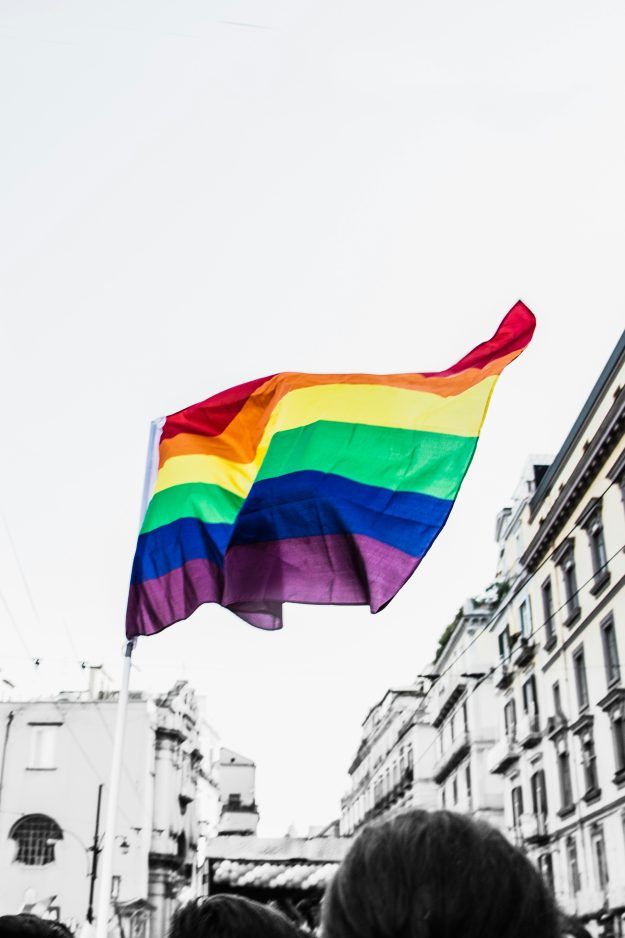
This month, we are celebrating the businesses that have helped push the Pride movement forward. (Photo Credit: Sara Rampazzo)
Because queer history is human history.
From a trans-owned restaurant to a wine shop championing equality, Pride takes many forms, in many places. Like Kimpton, which celebrates individuality and maintains a perfect score on the Human Rights Equality Index, these are the types of businesses that put people first and go the extra mile to ensure the inclusion of everyone. In honor of Pride Month, these are some powerful, inspiring, independent businesses that continue to pave the way for future progress.
Equality House
In the middle of the country, in the center of America’s heartland, a rainbow symbolizes love. Equality House is a rainbow-painted non-profit organization that serves as the hub for Planting Peace, which provides funds for conservation efforts across the globe. It’s also a symbol of Pride at its most intentional and purposeful, as the home is located directly across the street from the infamously homophobic Westboro Baptist Church.
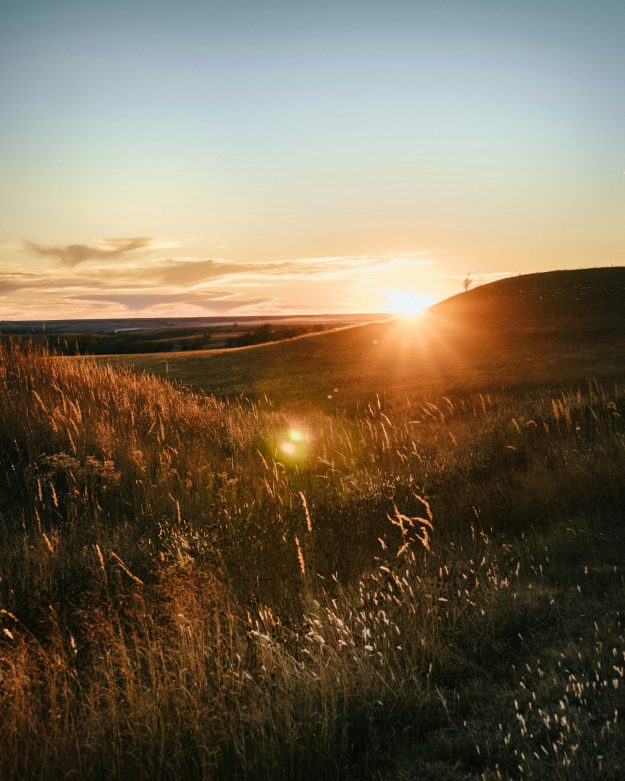
In the heart of America, Equality House is a haven for the LGBTQ+ community. (Photo Credit: Matt Phillips)
While Equality House is a non-profit, rather than a business, its work is pivotal — and defiantly, vibrantly visible. Guests can visit for photo ops and are welcome to pick vegetables from the on-site community garden.
Eureka Live
In the tiny town of Eureka Springs, a hilly enclave tucked inside the Arkansas Ozarks, Eureka Live is a bold beacon. Despite the town’s small size, Eureka Springs has a long-held reputation as a queer sanctuary in a historically conservative region. Here, rainbow stairs and sidewalks are omnipresent in the downtown district, as are queer-owned businesses and Pride events.
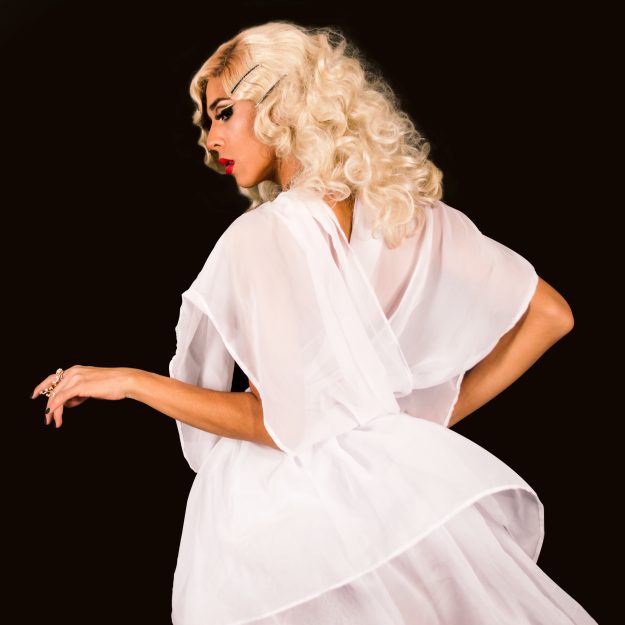
In small towns like Eureka Springs, gay nightlife is so much more than a dance floor. (Photo Credit: Dave Soto)
At the heart of it all is Eureka Live, a vast gay bar and club known for its spirited drag shows, parties, and late-night dancing. Gay nightlife is nothing new in and of itself, but in locales like this, far removed from big metropolises where LGBTQIA+ spaces are the norm, Eureka Live represents something far more important than a dance floor.
Lil’ Deb’s Oasis
Follow the rainbow-tinted dining room to Lil’ Deb’s Oasis, a kaleidoscopic eatery in New York’s Hudson Valley that loudly and proudly lives up to its moniker as a sanctum of individuality. The pan-Latin restaurant distinguishes itself at every turn, with lush menus as vibrant as the decor, and an altruistic mission to send money to racial justice organizations.
Owned by Halo Perez-Gallardo, the restaurant’s website puts its beliefs front-and-center, proclaiming that “warmth, nourishment, and connection are at the core of what we do.”

Say hello to Lil’ Deb’s Oasis. (Photo Credit: Heidi’s Bridge)

This gem is a jewel nestled in the Hudson Valley. (Photo Credit: Heidi’s Bridge)
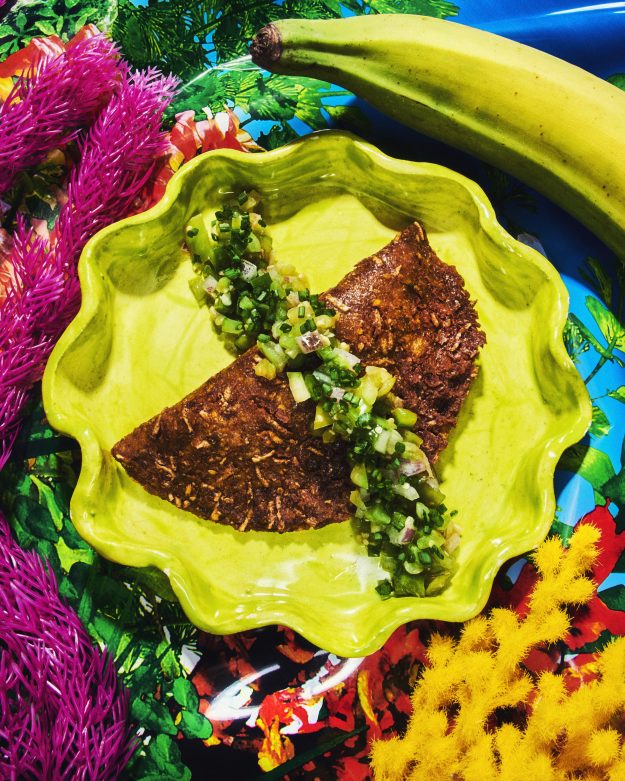
The food at Lil’ Deb’s is as vibrant as the decor. (Photo Credit: Bobby Doherty)
The food, billed as “tropical comfort,” is as unique as the motif — think sweet plantains with cilantro yogurt, roasted rainbow carrots with red pepper salsa macha, rooibos tea Cornish hen with celeriac and coconut, and pineapple upside-down cake with black sesame and bourbon caramel. New York may be famously progressive on the whole, but there’s something laudable about a business like this, nestled in the country, that waves its Pride flag for all to see.
Lil’s Kitchen
When Lil’s Bagels closed in Covington, Kentucky, the greater Cincinnati metro lost a beloved community cornerstone — one where Queer Soup Night provided a sanctuary, and owner Julia Keister served food as comforting as its inclusive environment. After its closure, though, she pivoted and partnered with Richard Hunt to revive the brand as Lil’s Kitchen inside the Dayton location of Roebling Point Books and Coffee.
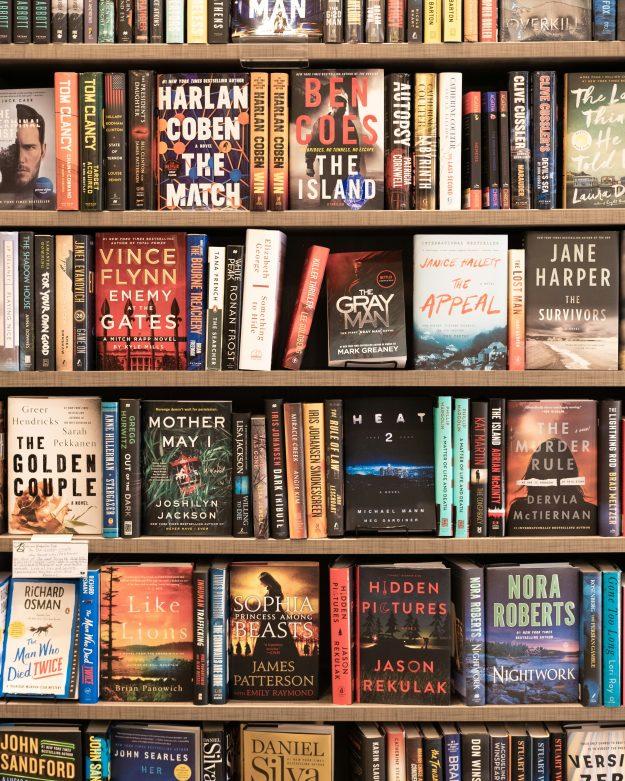
Nestled inside Roebling Point Books and Coffee you’ll find Lil’s Kitchen. (Photo Credit: Michael Newton)
Now, the bagels might be gone, but the Pride remains stronger than ever. The food menu skews Middle Eastern (e.g. tahini smoothies, Israeli couscous salad, hummus toast), using ingredients as wholesome as its sunny environs. The Instagram page proclaims, “Cooking up Queerness all over town,” by hosting Queer Soup Nights and fundraisers at events around Covington and Cincinnati.
Common Dear
Describing itself as a “queer women-owned feminist and self-empowerment gift shop,” Common Dear is among the proudest businesses in Oklahoma City — a rising metro that’s rapidly evolving from its conservative past into a city for all. Everything about the business, from the rainbow-colored stairs to its assortment of vibrant sundries, sings of Pride.
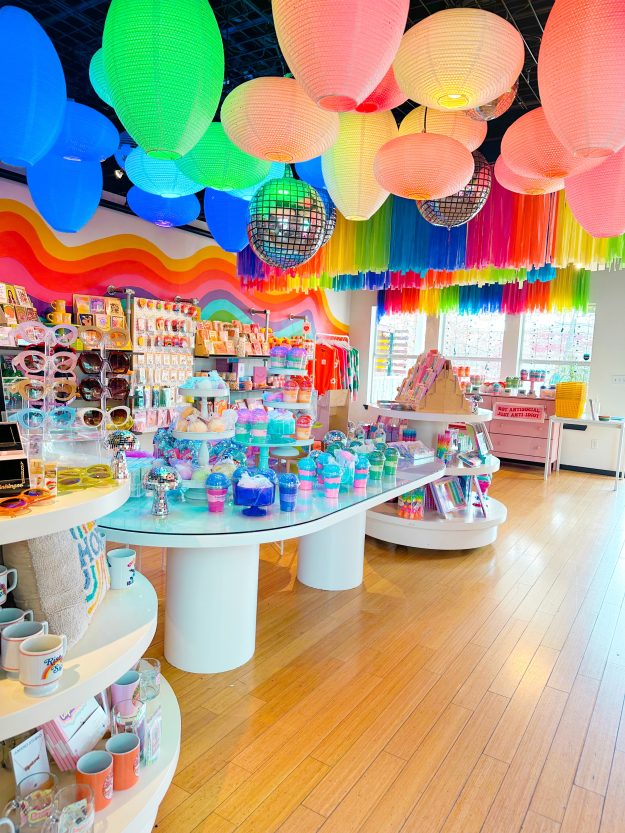
When in Oklahoma City, swing by this vibrant gem-of-a-shop. (Photo Credit: Common Dear)
Per the website, “we intentionally curate our Common Dear retail space with women-owned, 2SLGBTQIA+-owned and BIPOC-owned brands that care about empowerment and making the world a better, more equal place for everyone.” And they do so with a dynamic assortment of disco balls, rainbow pillows, Taylor Swift merch, fruity hair clips, “banned books,” floral sunglasses, Pride coloring books, and much more.
Neng Jr.’s
Asheville, of late, has been on the cutting edge of restaurant innovation. Along with recent paradigm-shifters, like Ashleigh Shanti’s Good Hot Fish, celebrating Black Appalachian culture and cuisine, Neng Jr.’s is another first-of-its-kind that’s helping to broaden culinary conversations.
The first Filipinx restaurant in town, it’s an intimate trans-owned concept from chef Silver Iocovozzi, whose ethos — per the restaurant’s website — is “to continue to evolve as a restaurant, care for our employees, and make changes as our world changes.”
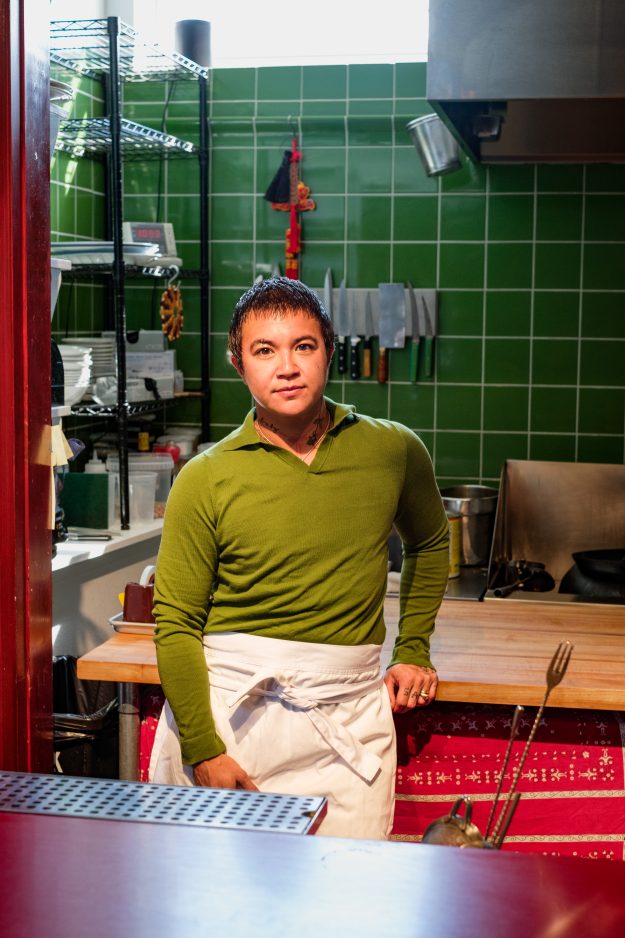
Neng Jr.’s is broadening the culinary conversation in Ashville. (Photo Credit: Dallas Houston)

Chef Silver Iocovozzi features a regularly rotating menu. (Photo Credit: Johnny Autry)

When in Ashville, Neng Jr.’s is an absolute must. (Photo Credit: Johnny Autry)
Since opening in 2022, the accolades have been swift and vast, with the likes of Bon Appétit and the James Beard Foundation praising it on a national scale. There’s been much ado about the buzzy newcomer, and rightfully so, as Iocovozzi showcases their skills and passions as a second-generation immigrant. The menu rotates regularly, and runs the gamut from smoked pork belly with banana ketchup red sauce to steamed bass wafting with coconut, ginger, and pea shoots.
When in Asheville, Kimpton Hotel Arras is the perfect jumping off point for exploring the city’s culinary delights from its downtown location surrounded by galleries, boutiques, and of course, Blue Ridge Mountain views.
Equality Vines
A wine shop in Sonoma County is a dime-a-dozen, but a wine shop that platforms causes, particularly those relating to LGBTQIA+ rights, is more of a unicorn. Nestled in the redwoods town of Guerneville, Equality Vines is a wine bar, bottle shop, and curated art gallery that’s so adamant about inclusion that it’s right there in the name — and on the labels.
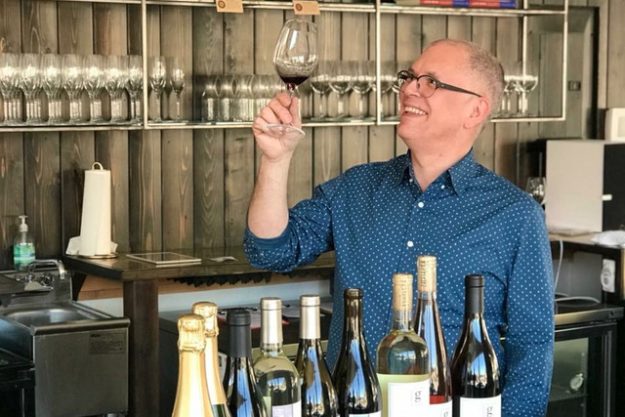
Welcome to Equality Vines, a jewel tucked amongst the redwoods of California. (Photo Credit: Matt Grove)

Equality Vines works with local winemakers and supports like-minded non-profits too. (Photo Credit: Matt Grove)
Co-owned by Jim Obergefell, a legend in the Pride movement for his US Supreme Court case, Obergefell v. Hodges, which culminated with same-sex marriage being federally legalized, Equality Vines bills itself the “world’s first cause wine portfolio,” working with local winemakers to create wines like “Love Wins” sparkling blanc de blanc, “Stonewall Zinfandel,” and “Rosé the Riveter.”
Not only are the wines of the utmost quality, but they go to a good cause, with proceeds going to likeminded non-profits, such as Family Equality, Lambda Legal and the League of Women Voters, and the YWCA.
Aspen Gay Ski Week
Although not a business, Aspen Gay Ski Week earns top marks for the pioneering fact that not only is it the first Gay Ski Week in the world (dating back nearly 50 years), and the largest in the western hemisphere, but it’s also the only one that’s a non-profit. Run by AspenOUT, and held annually in January, it’s a striking showcase of Pride from one of the world’s most famed ski resorts.

Say hello to Aspen (Gay Ski Week). (Photo Credit: Madison Kuhn)
For a sport dominated by elite, heteronormative stereotypes, Aspen Gay Ski Week helps to boldly break down barriers to entry, offering a week’s worth of events for all demographics and experience levels. It’s a time when rainbow flags billow throughout Aspen, when drag queens suit up and hit the slopes, when travelers let loose at pool parties and après-ski meet-ups, and when a giant Pride flag is skied down Aspen Mountain.
While fun and welcoming for all, the fact that Aspen Gay Ski Week still benefits AspenOUT, which supports LGBTQIA+ youth in the Roaring Fork Valley, is icing on the cake.
The Little Gay Shop
A little shop with a big mission, the aptly dubbed Little Gay Shop in Austin stands as a platform for local queer artists and creators. Located in East Austin, the pint-sized storefront is fronted by a bright-blue, rainbow-tinted facade, which gives way to a dizzying array of books, clothes, accessories, games, and much more.

The Little Gay Shop is a local gem in East Austin. (Photo Credit: Megan Bucknall)
Every item, and every trinket, is unabashedly queer, from the “Hot Homo” hot-pink socks and the “Y’all Means All” T-shirts, to the Pride-themed Mad Libs and the stickers emblazoned with rainbows, Marsha P. Johnson, and “These boots were made for smashing the binary.” Trans artists are particularly platformed, with a well-stocked array of books and goods from local trans makers.
The shop also runs The Little Gay Book Club, a free-to-join club that meets monthly to discuss different queer books.
Living Kitchen & Farm
A farm restaurant located in the woods off Route 66 in rural Oklahoma may not seem like the most obvious destination for a sense of Pride, but Living Kitchen & Farm defies expectations at every turn. An active farm and seasonal tasting menu restaurant, it’s the bucolic vision of partners Lisa Becklund and Linda Ford, who also own FarmBar and il seme in Tulsa.
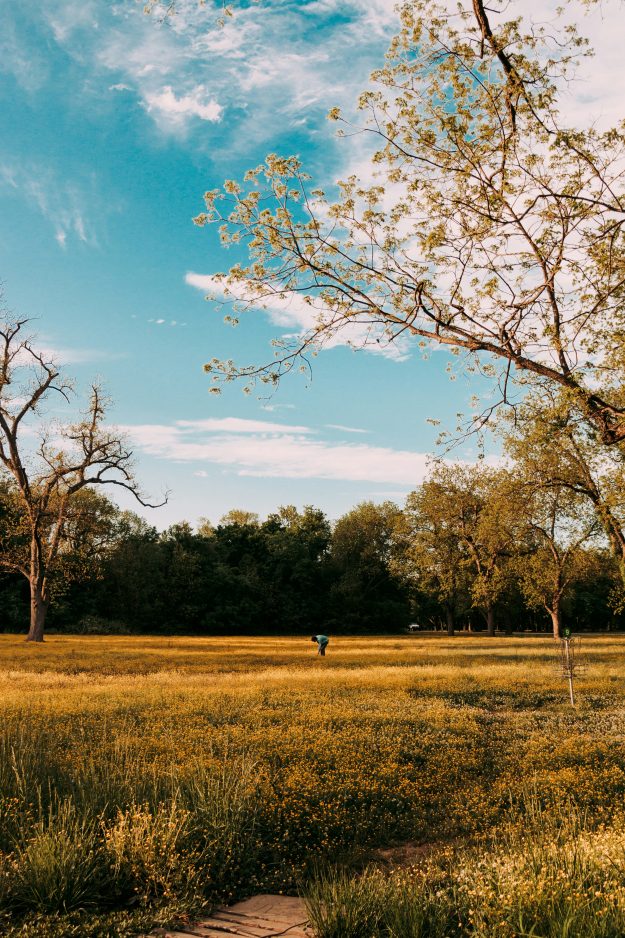
Rural Oklahoma is home to award-winning cuisine. (Photo Credit: Soroush Karimi)
Becklund, a Seattle native, first came to Oklahoma in 2005 to get into farming. A few years later, she was operating one of her own, along with her new partner, Ford. Together, they host elaborate and immersive farm dinners on a cottage porch, spring through fall. Even in a rural portion of the Bible Belt, the pair use food as the unifier to bring people together over a communal table, break bread, and share stories.
If ever there’s hope to change minds and open hearts, this is how it’s done. It helps that the multi-course meals are so good that Becklund has been long-listed for James Beard Awards on multiple occasions.
Cafe Lafitte in Exile
Nowadays, New Orleans is a city so famously come-as-you-are that it’s hard to imagine a time when gay bars had to hide in the closet. But as with the rest of the country, darker times once cast a shadow over this bastion of well-intentioned bacchanalia. Through it all, though, Cafe Lafitte’s reigns as the oldest continuously operating gay bar in the entire country — an icon of resilience, endurance, and the power of community.
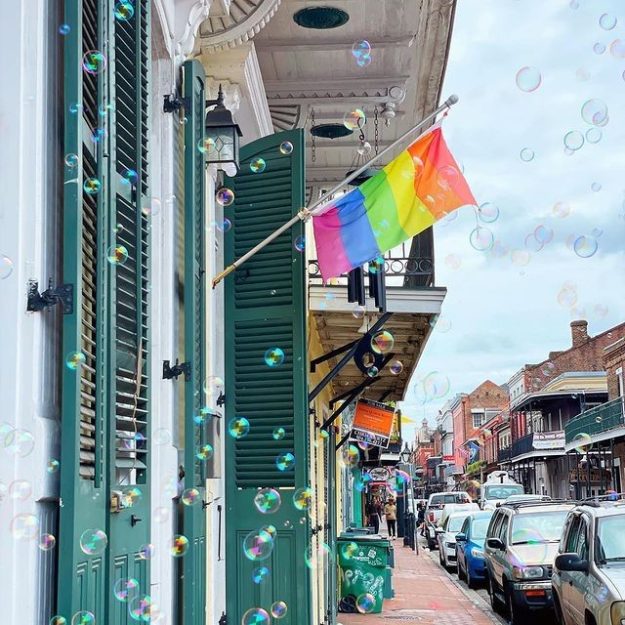
Welcome to the French Quarter of NOLA. (Photo Credit: @hotelfontenot)

Cheers to these powerful, inspiring, independent businesses that continue to pave the way for future progress.
Dating all the way back to 1933, the nearly century-old bar has served customers like Truman Capote from its original location in the French Quarter (Lafitte’s Blacksmith Shop currently resides in that original building). Since moving to its current French Quarter locale in 1953, as a result of a landlord who forced it out of its original home, Cafe Lafitte’s cheekily re-dubbed itself Cafe Lafitte in Exile.
Even as gay bars have become far more normalized across the country, this is one that’s stood as a timeless watering hole for all — where Pride flags are omnipresent, the doors never close, and love is love.
On the edge of the French Quarter, Kimpton Hotel Fontenot is a beautiful place to stay — and sip, particularly at the Peacock Room, a lounge as fabulous as the name suggests.